Geodesic Boards
A set of CNC-carved wooden boards that make geodesic curves on mathematical surfaces tangible and touchable. Joint work with Steve Trettel
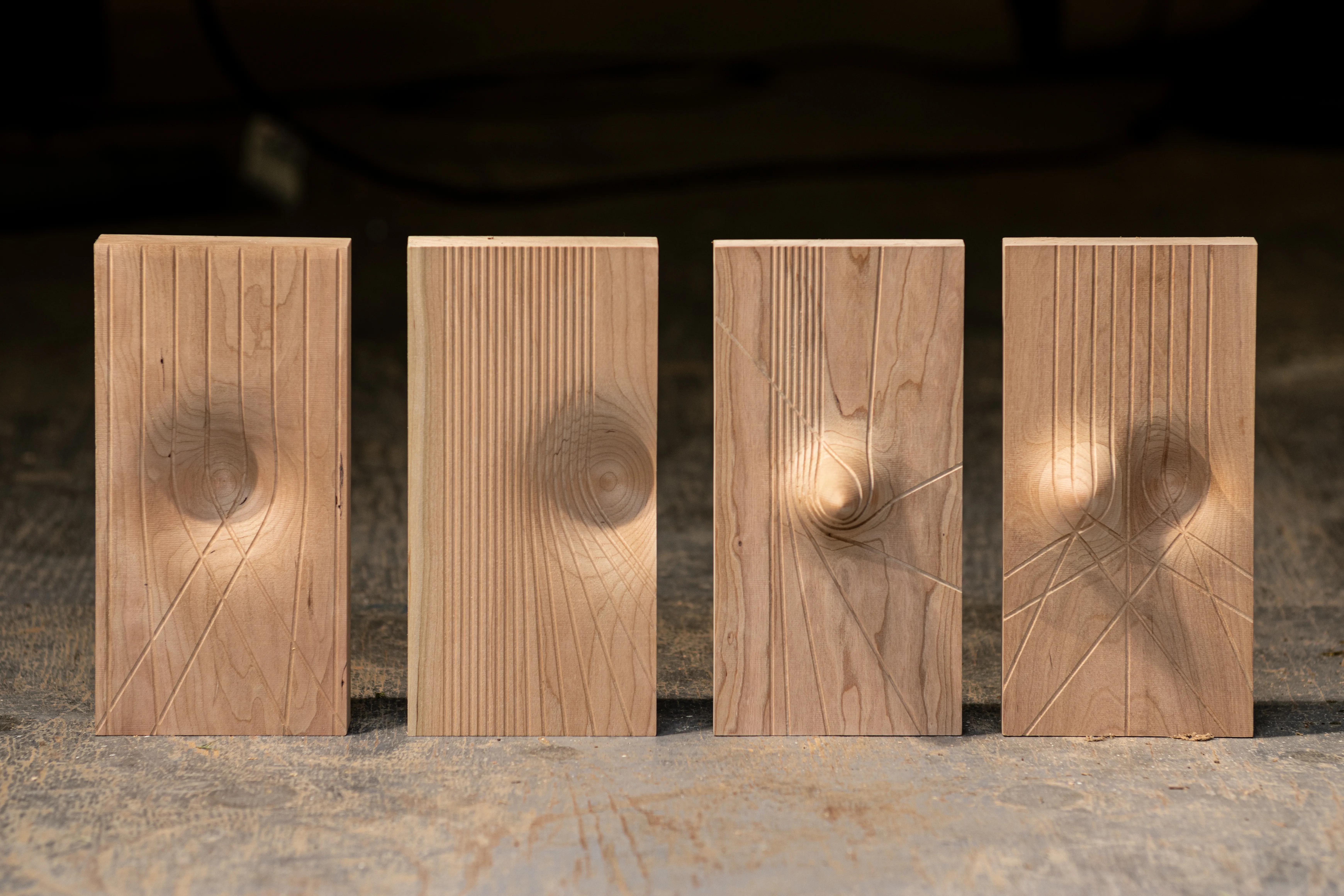
The boards are a collaboration with Steve Trettel, and they explore geodesics and the way a mathematical manipulative can take advantage of both digital and physical forms using the strengths of each.
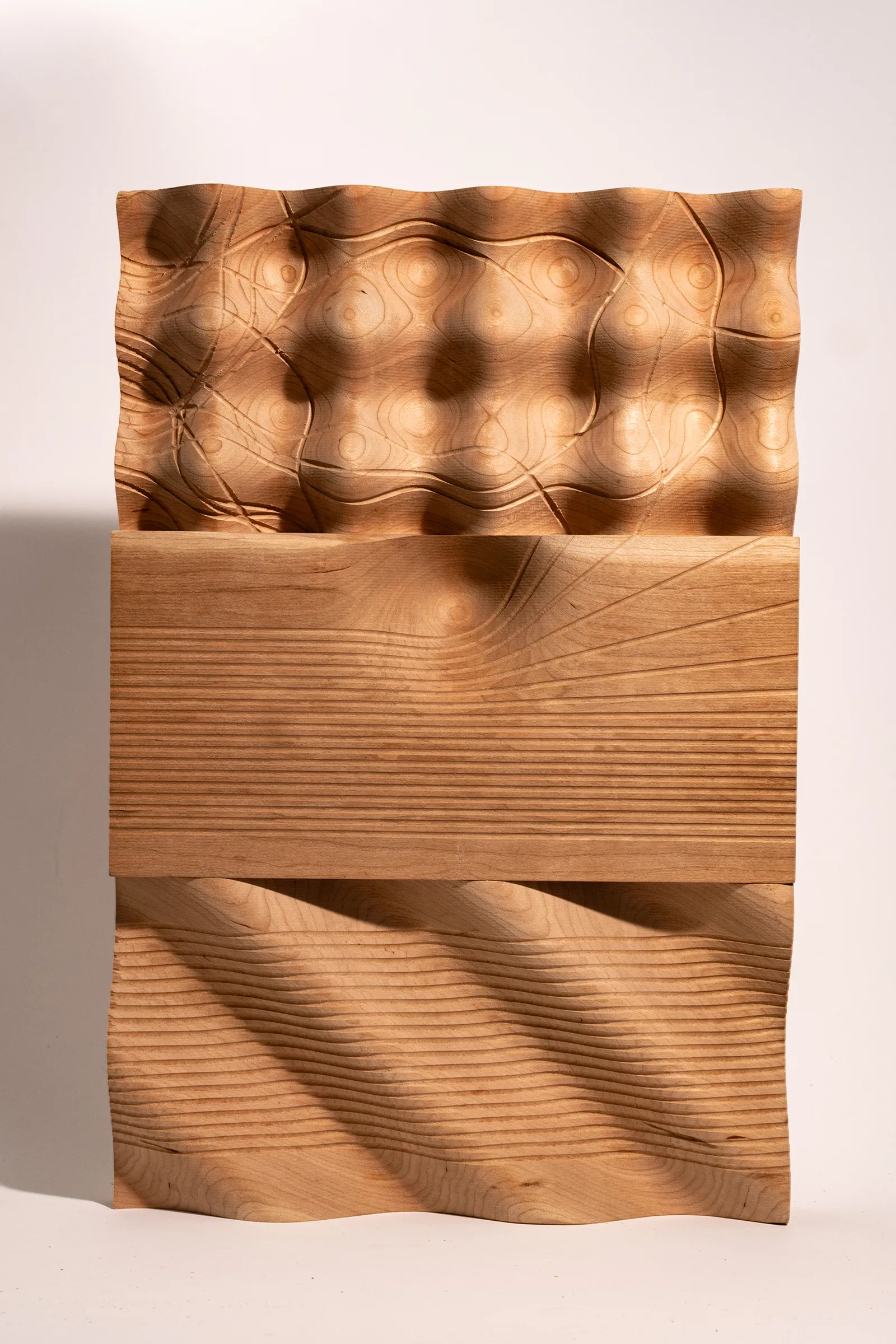
Each board encodes a different surface (bump, saddle, double-bump, egg-carton, wave) and the carved grooves trace geodesics whose behaviour reveals the local curvature: a positive-curvature bump focuses them, a negative-curvature saddle spreads them, a developable surface keeps them parallel. The project grew out of research into illustrating mathematics through CNC craft, and raises precise questions about what it means for a physical object to faithfully represent a mathematical idea.
Alongside the boards is a geodesic calculator that allows the design of the boards. The calculator defines a surface as a function, approximates parallel transport to propagate a family of geodesics, and returns the results as lists of points and surface normals. On the CNC side I use that information to create the desired board through a mostly automated process.
A geodesic on a surface is the straightest possible path: what a stretched string settles into when constrained to lie on a curved surface, or equivalently the path a particle takes when it feels no force except the surface itself. On a flat plane, geodesics are straight lines and they behave simply: parallel geodesics stay parallel, and nearby geodesics neither approach nor diverge. On a curved surface, this changes. The curvature of the surface acts on geodesics they move together or apart depending on the underlying geometry.
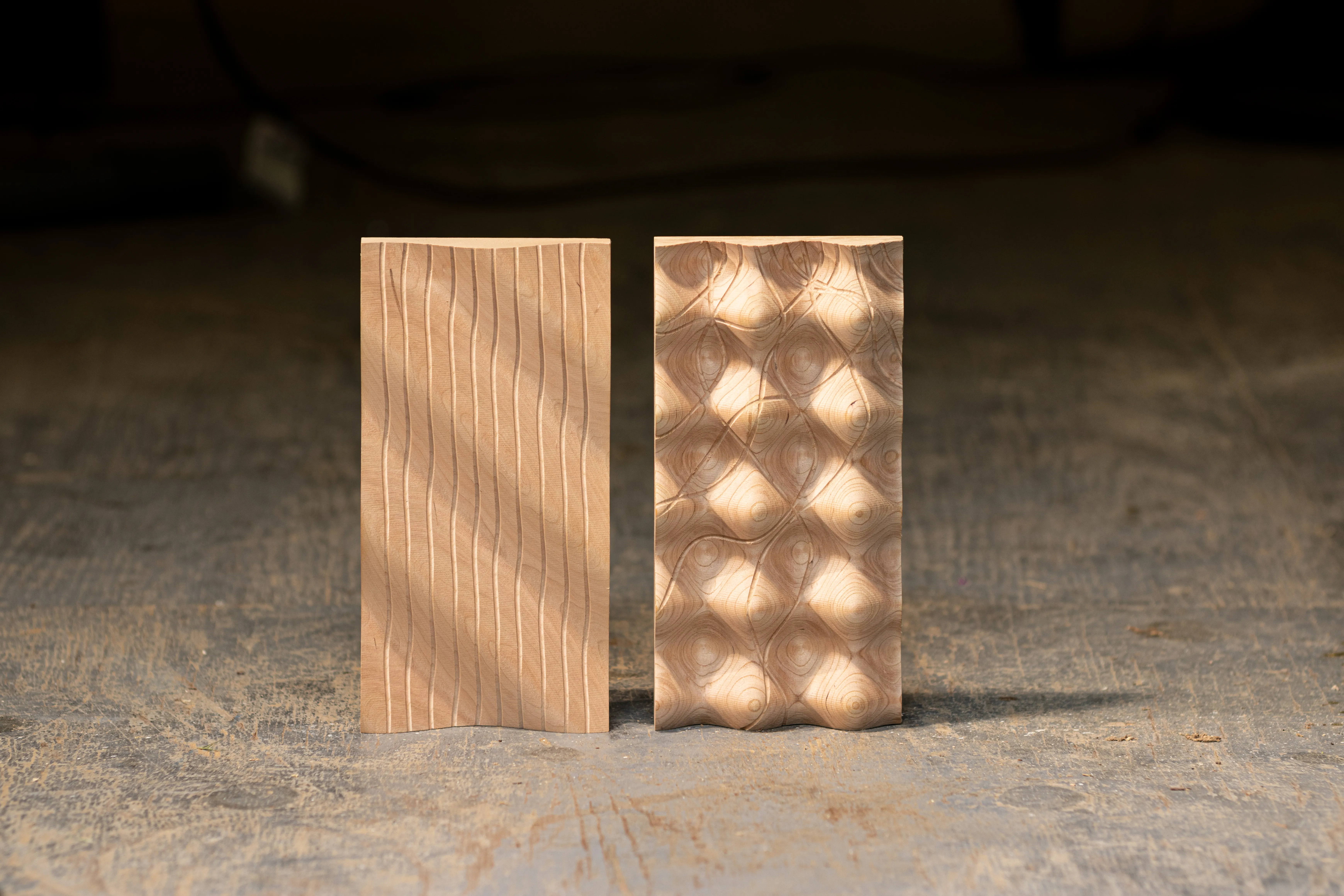
Each board in this set is CNC-carved from wood to encode different properties of geodesics. A positive-curvature bump focuses geodesics toward one another, a negative-curvature saddle drives them apart, and a developable surface keeps them exactly parallel no matter how far they travel. On the egg-carton surface the geodesics become chaotic: small changes in launch position produce wildly different long-run paths.
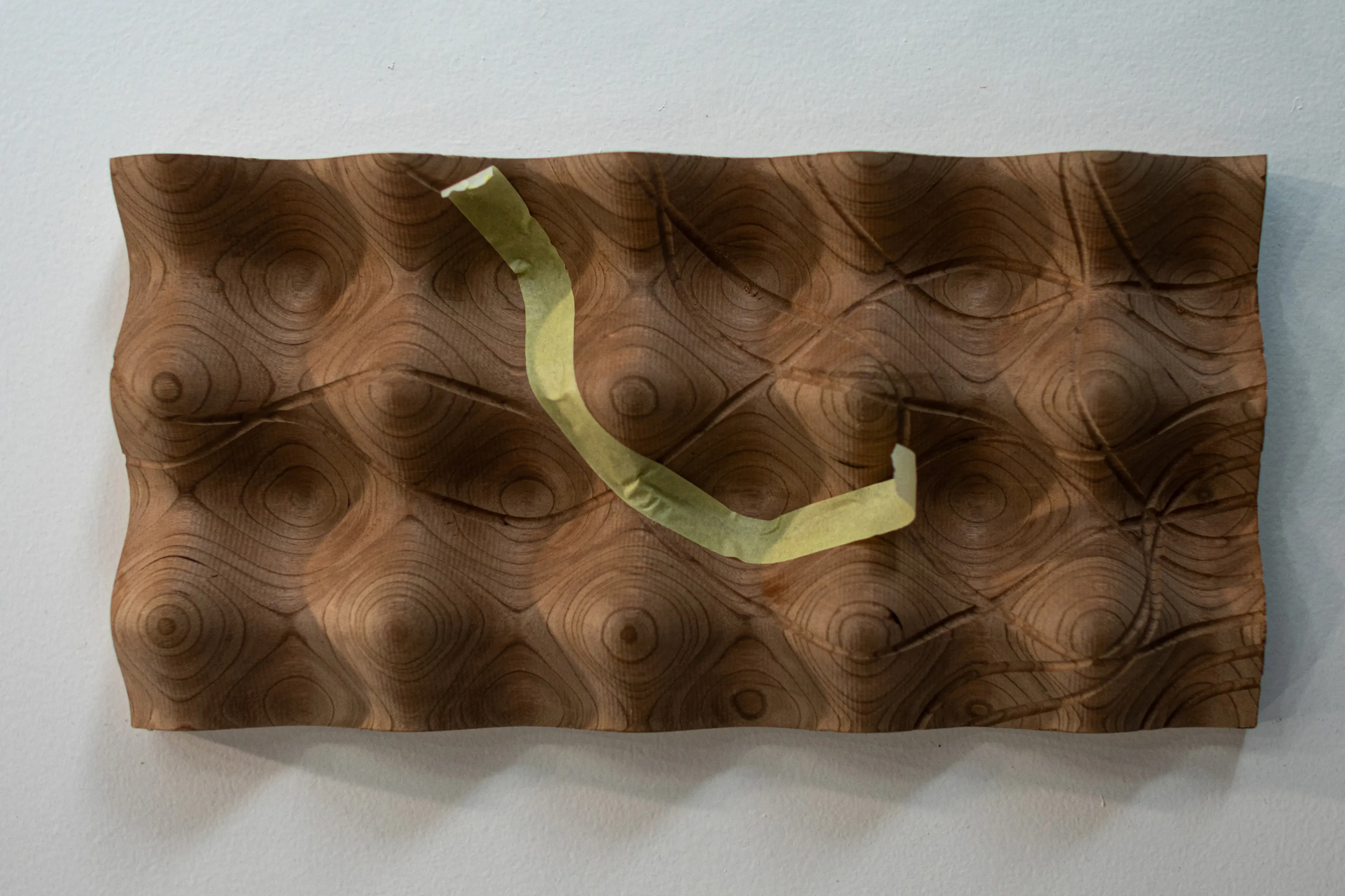
The boards are intended to be touched. Tracing a finger along a groove gives direct access to something usually encountered only through equations, the experience of a curve that is locally straight but globally shaped by curvature. The “Do Touch” note placed with the boards is not incidental. As a finger moves along a groove you can feel both sides moving at the same speed.
There are interactive browser versions of the same system. The 2023 geodesics graphing calculator lets you define any surface and fire geodesics across it. The 2025 demo series includes dedicated interactive boards for each of the physical surfaces (NYC I and II, egg-carton, Gaussian bumps (I–IV), and waves) where you can drag to aim geodesics and switch between surface presets to see exactly the focusing, spreading, and chaos the wooden boards make tangible.