About
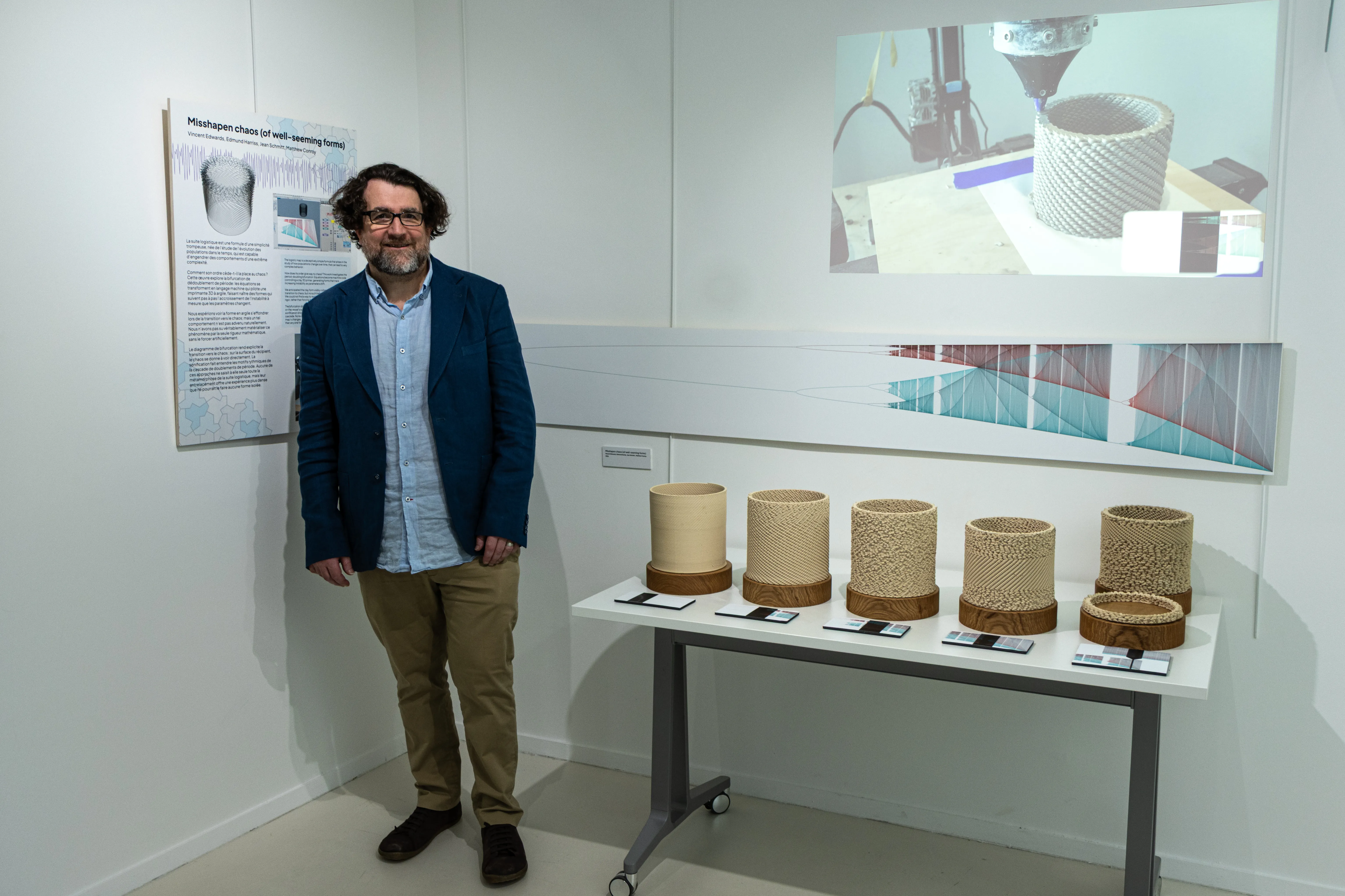
Edmund Harriss is a mathematician, artist, and author, and an Assistant Professor at the University of Arkansas. His research centres on mathematical illustration: how visual form, physical construction, and perception can communicate deep mathematical ideas and serve as genuine tools for discovery. He participated in the Illustrating Mathematics semester at ICERM, Brown University (2019) and co-organised the IHP trimester on Illustration as a Mathematical Research Technique at Institut Henri Poincaré, Paris (2026). He has published on the subject in "The Art of Illustrating Mathematics" (with Henry Segerman, Journal of Mathematics and the Arts, 2022) and "On the Importance of Illustration for Mathematical Research" (Notices of the AMS, 2024). His own research has produced visual objects that bridge mathematical discovery and art: the Harriss spiral, a fractal curve arising from the plastic ratio featured in the Guardian in 2015, and Algebraic Starscapes, which plots algebraic numbers at scales set by their complexity to reveal hidden geometric structure (Experimental Mathematics, with Stange and Trettel, 2022).
Alongside the mathematics, Harriss makes art. He invented Curvahedra, a sculptural construction system grounded in the Gauss-Bonnet theorem, with pieces installed at the University of Arkansas, Oklahoma State University, and Imperial College London. He was a core member of the team behind Mathemalchemy, a large-scale collaborative installation by 24 mathematicians and artists that toured the United States from the National Academy of Sciences through MoMath and beyond. With Alex Bellos he co-authored the mathematical colouring books Patterns of the Universe (2015) and Visions of the Universe (2016), together selling over 100,000 copies, and the children's counting book Hello Numbers! (2020). His work has been featured in the New York Times, the Guardian, NPR, and New Scientist.
Contact: eharriss@uark.edu