IHP Trimester: Illustration as a Mathematical Research Technique
Trimester at Institut Henri Poincaré, Paris, examining illustration as a mathematical research techniques. I was a co-organiser.
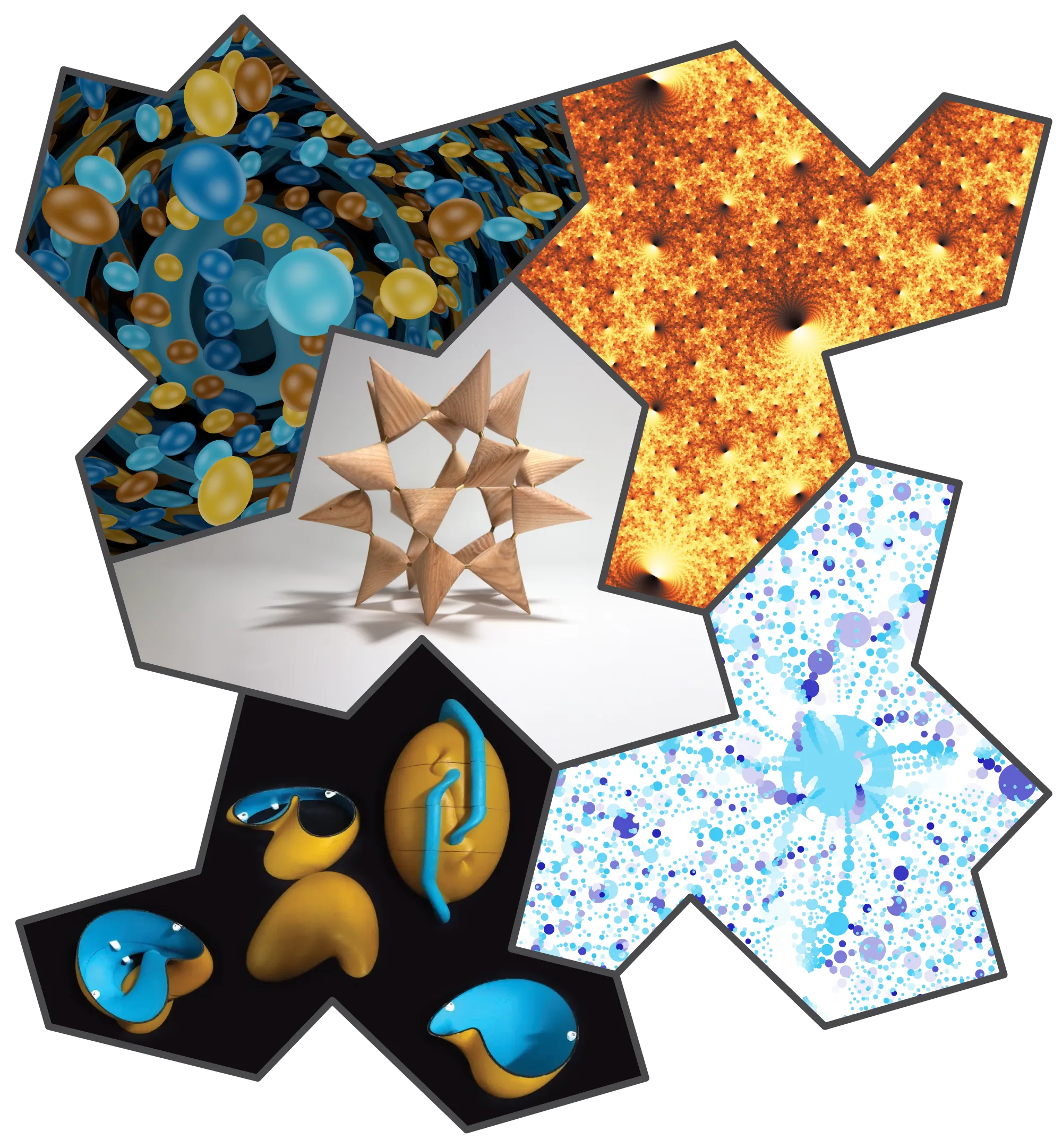
The Illustrating Math community that came together from an ICERM meeting in 2016 and full semester in 2019 worked on the next step. The result was this trimester program at IHP, from January to April 2026. The trimester proposal became a paper in Notices of the AMS.
I co-organised the programme with David Bachman, Rémi Coulon, Gabriel Dorfsman-Hopkins, Martin Skrodzki, Katherine Stange, and Glen Whitney. The programme opened with an introductory school at CIRM in Marseille (January 5–9), then moved to Paris for three workshops:
- Rigorous Illustrations: Their Creation and Evaluation for Mathematical Research (January 19–23)
- Bridging Visualisation and Understanding in Geometry and Topology (February 16–20)
- Integrating Research and Illustration in Number Theory (March 23–27)
Following the trimester, at Maison Poincaré, I was one of the curators of the exhibition Creation: Between Art and Mathematics.
Why rigorous illustration?
The opening conference tried to frame an important question and challenge for the community. How to consider illustration robustly within mathematics, especially beyond diagram and intuition?
My own framing, given in the opening lecture, is to consider illustration as a dual to modelling. When we model a physical process mathematically, we try to create a mathematical system that captures its behaviour. When we illustrate a mathematical idea, we do the reverse: we create a physical or visual system that is governed by the mathematical structure.
What I took away from the trimester
The trimester landed at a charged moment for its own question. With the Leiden Declaration and the arrival of machine proof, mathematicians are again asking what counts as mathematical knowledge: if a system can certify a theorem without illuminating it, what have we gained? Illustration can play a powerful role in answering this, going beyond an aid to intuition and being a companion to formalism. A diagram can carry weight inside a proof, and a good illustration can be interrogated as carefully as the proof it sits beside.
My second takeaway was the importance of shaders as a technology for illustration. A fragment shader is a mathematical object in its own right, a function from the plane to a colour space. The image it produces is implicit in the code, so a proof is needed to say what that image can and cannot be trusted to show. A shader is fast, mathematically simple to describe, and its affordances can be queried precisely, which makes it an exciting and relatively underexplored technology to add to the arsenal of illustration tools. The way it moves from image back to mathematics (where most tools render a defined mathematical form) makes the thinking that it supports genuinely different.